Yesterday was a 'camper' day as I decided to start trying to improve the cosmetics a little.
As is evident in this picture from last year when I was removing the stickers, some paint had lifted off the passenger door. (look carefully in the crease line). As I recall it wasn't on the latest stickers, but some time earlier in the life of the vehicle.
This made the vehicle look tatty, so having located a better door, I went and collected and fitted it yesterday (picture when I manage to download it off the phone). This had the advantage of not waiting for paint to dry and the new door comes off a much newer vehicle so hopefully less time before rust sets.
Showing posts with label Camper. Show all posts
Sunday, 26 September 2010
Monday, 13 September 2010
Camper Part 33: Quick update
Progress has continued on the camper, albeit at a slowish pace.
Since the last post I have refreshed the MOT. The was initially a failure on the fog light switch being loose (I was due to pick up a replace dash the following day so took a chance) and the number plate lights.
These lights are located on the fold out step and wired via brass/copper contacts that only make a connect when the step is folded away. As the step is quite worn the contact is hit and miss. The was on a Saturday so the tester gave me 2 hours to go away and rectify the two problems. The fog switch problem I resolved my knocking up a plywood insert for the dash in place of the broken plastic, whereas I ripped out the contacts and ran folding loom in for the steps. I know this isn't ideal but I intend to replace these steps with a proper motorhome type fold out set which should be much lighter (not being engineered for stretchers, etc).
I also managed to fit all the cupboard doors, the cooker and fridge (they've been in before, but are now in their final fix). The only remaining item on the cupboards are the shelves (simple 3mm ply planned) and the drawer which I need to make and fit.
I also sourced an ex caravan bedframe to make the junior over seat bed in the cab and pieces of another double front seat to allow me to add a second seatbelt to the twin rear seats.
My current focus is on items which prevent use of the vehicle as opposed to the nice to haves. This isn't stopping the collection of usefull bits though.
The vehicle has also seen some use on the road with trips varying from 400 miles one day to around 80 a few times for localish trips.
I had a problem on one of the trips when the valve on one of the wheels failed, luckily on a small road with a handy layby ahead. Only problem I still hadn't sourced a spare (it came with none). If anyone knows where I can get a 15 inch twin wheel Sprinter wheel cheap (don't care about the tyre), please shout.
That's all for today....
Since the last post I have refreshed the MOT. The was initially a failure on the fog light switch being loose (I was due to pick up a replace dash the following day so took a chance) and the number plate lights.
These lights are located on the fold out step and wired via brass/copper contacts that only make a connect when the step is folded away. As the step is quite worn the contact is hit and miss. The was on a Saturday so the tester gave me 2 hours to go away and rectify the two problems. The fog switch problem I resolved my knocking up a plywood insert for the dash in place of the broken plastic, whereas I ripped out the contacts and ran folding loom in for the steps. I know this isn't ideal but I intend to replace these steps with a proper motorhome type fold out set which should be much lighter (not being engineered for stretchers, etc).
I also managed to fit all the cupboard doors, the cooker and fridge (they've been in before, but are now in their final fix). The only remaining item on the cupboards are the shelves (simple 3mm ply planned) and the drawer which I need to make and fit.
I also sourced an ex caravan bedframe to make the junior over seat bed in the cab and pieces of another double front seat to allow me to add a second seatbelt to the twin rear seats.
My current focus is on items which prevent use of the vehicle as opposed to the nice to haves. This isn't stopping the collection of usefull bits though.
The vehicle has also seen some use on the road with trips varying from 400 miles one day to around 80 a few times for localish trips.
I had a problem on one of the trips when the valve on one of the wheels failed, luckily on a small road with a handy layby ahead. Only problem I still hadn't sourced a spare (it came with none). If anyone knows where I can get a 15 inch twin wheel Sprinter wheel cheap (don't care about the tyre), please shout.
That's all for today....
Sunday, 8 August 2010
Camper Part 32: Calorifier Cabinet
If you've been following this build then you may recall that I bought a Surecal calorifier from Surejust, together with a matching expansion tank and accumulator.
For more information, choose the 'Bathroom' label on the menu.
The intended location of these parts and the pump, etc is under the floor, outside the chassis, behind the side skirt. The ambulance body has outriggers which are bolted to the chassis and hold the floor. I had previously made some brackets for the calorifier and drilled holes in the outriggers for the expansion tank and accumulator (they're the same thing but run at different pressures for different purposes).
As the calorifier has an expanded foam jacket which is easily damaged (and is quite expensive), I wanted to protect it. There is also the cold in winter to be concerned about.
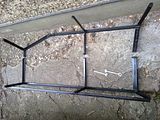
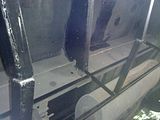
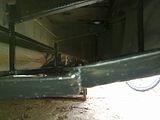
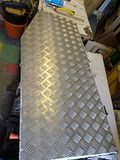
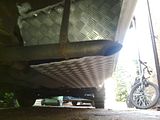
To this end I have created a cabinet to protect these precious items from the elements and road debris. The structure of the cabinet is an angle iron frame which is bolted (and bonded with seam sealant - like Sikaflex but not) to the outriggers, chassis rail and side skirt. The sides and rear were then covered with some aluminium checker plate scraps left over from another project.
When making the frame, the trickest part was getting all the bits to align. I made the one half, bolted that in place and then made cardboard templates and made up the other half. I then also just tacked the pieces together and kept test fitting before the final weld. This was one of the big reasons for it taking so long as I started this part in December last year and gave up during the cold winter.
When doing the aluminium side panels, what you can't see is that they come all way to the side skirts. Here I again used the cardboard template technique to make a pattern which I then cut out in aluminium and fitted. The cladding is glued in place with seam sealant and pop-riveted to the frame. The joint with the side skirts is simply glued.
The door/lid/cover is constructed in a similar manner, but from square tubing. For hinges, I had one half of a pair of 'rising' house door hinges, and made the other half out of angle iron and some old 8mm bolts. By doing it this way, the cover is removable for working/inspection, or can just be hinged down for quick access. TIP: I made the one hinge pin longer than the other so that it is easy to align if you are doing this by yourself. The door is held closed by 2 M6 bolts (I drilled and tapped M6 threads into the frame), I figured this should be pretty safe as I don't want it coming open while driving.
I intend to still line the whole cabinet with Kingspan (or similar). The pipes themselves will get foam covering. I am also considering some form of electric heating elements as has been discussed in the forum. I'm not rushing this part of things as I don't currently intend to venture to really cold climes in the depths of winter, but I would like to find a suitable product at my kind of price (i.e. cheap or free), now where did I put those heated seat elements I removed from the Galaxy seats when making the Frankenseats......
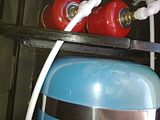
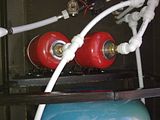
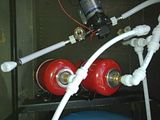
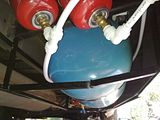
The series of pictures below show the frame in various stages of the construction (I had to make it in two parts and bolt it together to get it under the skirt). These are then followed by pictures of the water system parts and plumbing in place, and finally a couple of pictures of the closed cabinet.
Bare frame before fitting:
Calorifier, expansion tank and accumulator in place:
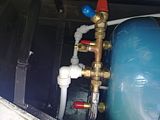
Aluminium cladding:
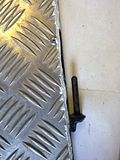
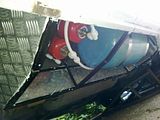
The final product:
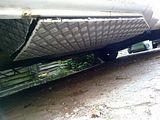
For more information, choose the 'Bathroom' label on the menu.
The intended location of these parts and the pump, etc is under the floor, outside the chassis, behind the side skirt. The ambulance body has outriggers which are bolted to the chassis and hold the floor. I had previously made some brackets for the calorifier and drilled holes in the outriggers for the expansion tank and accumulator (they're the same thing but run at different pressures for different purposes).
As the calorifier has an expanded foam jacket which is easily damaged (and is quite expensive), I wanted to protect it. There is also the cold in winter to be concerned about.
To this end I have created a cabinet to protect these precious items from the elements and road debris. The structure of the cabinet is an angle iron frame which is bolted (and bonded with seam sealant - like Sikaflex but not) to the outriggers, chassis rail and side skirt. The sides and rear were then covered with some aluminium checker plate scraps left over from another project.
When making the frame, the trickest part was getting all the bits to align. I made the one half, bolted that in place and then made cardboard templates and made up the other half. I then also just tacked the pieces together and kept test fitting before the final weld. This was one of the big reasons for it taking so long as I started this part in December last year and gave up during the cold winter.
When doing the aluminium side panels, what you can't see is that they come all way to the side skirts. Here I again used the cardboard template technique to make a pattern which I then cut out in aluminium and fitted. The cladding is glued in place with seam sealant and pop-riveted to the frame. The joint with the side skirts is simply glued.
The door/lid/cover is constructed in a similar manner, but from square tubing. For hinges, I had one half of a pair of 'rising' house door hinges, and made the other half out of angle iron and some old 8mm bolts. By doing it this way, the cover is removable for working/inspection, or can just be hinged down for quick access. TIP: I made the one hinge pin longer than the other so that it is easy to align if you are doing this by yourself. The door is held closed by 2 M6 bolts (I drilled and tapped M6 threads into the frame), I figured this should be pretty safe as I don't want it coming open while driving.
I intend to still line the whole cabinet with Kingspan (or similar). The pipes themselves will get foam covering. I am also considering some form of electric heating elements as has been discussed in the forum. I'm not rushing this part of things as I don't currently intend to venture to really cold climes in the depths of winter, but I would like to find a suitable product at my kind of price (i.e. cheap or free), now where did I put those heated seat elements I removed from the Galaxy seats when making the Frankenseats......
The series of pictures below show the frame in various stages of the construction (I had to make it in two parts and bolt it together to get it under the skirt). These are then followed by pictures of the water system parts and plumbing in place, and finally a couple of pictures of the closed cabinet.
Bare frame before fitting:


Calorifier, expansion tank and accumulator in place:


Aluminium cladding:


The final product:


Sunday, 25 July 2010
Camper Part 31: Frankenseats 2
In part 1 of Frankenseats I reported on the successful completion of the the Volvo-Ford-Mercedes swivel bases.
Well, today I managed to assemble the seats back onto the bases and fitted them to the vehicle, having made wiring looms yesterday.
The pictures below show the seats in various orientations. As mentioned before, this version has the electrics working, but the swivel isn't quite sorted as the handle for the safety lock release needs to be made. Don't worry, the safety lock does engage, it's the disengaging that takes some effort (but I can do it, so swivel does work).
I haven't driven with these seats yet, but I fully expect them to be much more comfortable as I had one of the Volvo 960's for a while. The other bonus is that I didn't have to modify the handbrake mechanism as so many people seem to have to with the commercial swivels.
Monday, 12 July 2010
Camper Part 30: Frankenseats 1
And you all thought I'd forgotten about the camper.
It's been a bit of a juggling act with all my projects, but I tend to switch when I get stuck for one reason or another.
For the camper I figured I needed some swivelling seat bases. Having also once been the proud owner of a Volvo 960 with electric memory seats, I knew that these would be much nicer than that standard Sprinter seats. Especially in leather with a heater element.
Well, I managed to get some of the appropriate leather seats from Pete & Roger, and keeping an eye out on Ebay I managed to land a set of Ford Galaxy (same as the Seat Alhambra and VW Sharan) swivelling front seats at a decent price.
Then the surgery began. I stripped down the Galaxy seats to get at the swivel. Lots of measuring later I had figured out how to mate these to the Volvo seats and Sprinter bases. It's really handy that the sliding base unbolts from the Volvo seats allow easy working in the workshop (I only figured this out part way through the build though - which has been ongoing since December).
I ran into some trouble with one of the bases so had to aquire another seat from Roger. Luckily this was another driver seats which allowed me to fit both seats with the memory module and motors (the passenger seat is electric, but no memory).
Last night I eventually managed to finally assemble the frankenseat bases. The pictures below show a partially dismantled base while I was replacing the motors, followed by the two assembled bases.
The next instalment will see these fitted to the camper. Version 1 will have electrical control but no swivel as I still have to make a handle for releasing the safety catch. I do however need to use the vehicle so need to get the seats in.
Sunday, 20 June 2010
Camper Part 29: Delightful Doors
You may recall that while I provided a detailed blog on the creation of the kitchen unit carcasses, I kind of skipped over the details relating to the worktops and getting the cooker and fridge in place as I was preparing for the MOT.
At that point, while I had created the carcasses, fitted sides, counter tops and the cooker and fridge. I had not yet actually panelled the front or fitted doors, drawers, etc.
The plan was to fit a complete sheet of 3mm plywood over the front of the carcass and then cut out the holes. This means that there will be few or no join lines on the front surface of the units. It also means that I could use the pieces cut out of the holes as the infill panels on the doors.
Earlier this year (just as the snow stopped) I started on the camper again and this was the job I tackled. Once I had the holes cut out (I can't get pictures right now as the camper is acting as storage for it's constituent bits), I was able to measure up the door sizes.
The doors are made of 32mm x 16mm pine batten (similar to what was used for the carcasses). The battens are formed into a rectangle with the left over plywood as an infill panel (kind of like a picture frame). This allows the door to overlap the carcass by around 10mm all round.
I decided I didn't want to get to fancy on the detailing as this is a budget camper, so the approach I took was as follows:
- Using my home table saw (I made a table to fit by handheld circular saw to), I cut a 3mm rebate into the batten for recessing the 3mm ply into later.
- I cut all the pieces to length with a 45 degree angle on each end for joining up. I tried to do this with a hand saw and normal mitre box, but its difficult to be accurate so I bought a cheap motorised mitre box (i.e. basic chop saw) on Ebay. It's amazing how much easier things are with the right tools.
- I had bought a band clamp from B&Q, so over the period of a week I clamped up all 6 frames (each had to stay in the clamp for at least 12 hours).
- The next step was to cut the plywood accurately to size. I did this by finding the center and measuring out from there so that the visible grain will match the carcasses. I did the cutting on my new (to me) band saw (Ebay again, it came with 3 spare blades and half the new price). Again proving the benefits of the right tools as there was no splitting of the ply as when cut by hand.
- The frames where then sanded to level out any gluing imperfections and then using a round over router bit in my new (to me) (Ebay) router table I rounded over the inside and outside edges.
- The final step was to glue and pin the ply insets into the frames. When they are dry Lorraine will help by doing the varnishing (she's the painter in the family). The carcasses will be done at the same time as they have already been sanded and are waiting for this point in time.
If the above is unclear then hopefully the following pictures will help make it clear.
Hinges and handles will only go on when they are fitted. The 3 smaller ones fit horizontally while the other 3 are vertical (i.e. the grain is always vertical). The narrower of the two smaller ones go under the sink. One will be a drawer front (under the draining board), while the other will be a false front, but I will make it open to give access to a shallow space above the fridge which will allow for storage of paperwork, etc.
Saturday, 19 June 2010
I'm back!!
I haven't blogged for a while as work, winter, family and other crisis have intervened to conspire against me.
But enough of the excuses, what have I been up to in the intervening time??
- Lorraine's Lair has been completed (more pictures soon) and she has moved in. She uses it for arts and crafts as well as doing her Scout's admin (she runs Kyle's Cub Scout Pack).
- I have made very LITTLE progress on the ambulance. I started on the frame for the water system, but winter intervened and I didn't feel like lying on my back on the drive so the whole project got parked. Earlier this year I managed to progress with finalising the kitchen cupboards (more in the next post).
- I acquired an Armdroid robot arm (always wanted something like this since using one while doing my engineering degree). I spent some time trying to get it going without much success. Keep an eye out as it will be resurrected (probably with new electronics). Not soon though.
- The robot arm reminded me of my intention to build a CNC lathe and also an interest in the RepRap project. I have now collected most of the bits to build a Mendel. The only bits I need are the plastic bits, but as they are very expensive I will be creating a RepStrap with wood (I'll blog more on the details later).
- The above projects were taking place on the dining room table. Lorraine decided that the remaining half of the shed should become Craig's Corner instead of storage. This was my birthday gift, but as I am the only one in the household capable of doing the work I ended up making my own present. (Pictures will follow in a later article along with the Lorraine's Lair update.)
- I've also helped my brother setup a blog as he is building a boat. Read about it here!
- Finally (well, out of the highlights), our landlord came a removed a number of bits from the house and garage so this has given me some more space.
Sunday, 18 October 2009
Camper Part 28: Oily bits today...
One of Kyle's friends from Milton Keynes invited him to his sleep-over birthday party yesterday so Lorraine and I had to agree on a strategy for the two 140 mile round trips.
I took the opportunity to spend yesterday at the workshop (which is outside Milton Keynes) with Pete, Mark and Roger as the friend's mom kindly agreed that Kyle could spend the whole day with them. Lorraine did the collecting and tied it in with visiting some friends in Milton Keynes.
As Peter had previously picked up a selection of filters (air, oil, fuel) for the Sprinter, I decided that this would be a good day to do the fluid changes which I had been putting.
On arrival at the workshop I first decided to do the weather sealing of the toilet door which I had also neglected since fitting the door a few weeks back. I removed the door and using my favourite sealant proceeded to seal in the ply spacers and then sealed the door frame in the place as well. I had to use some ply packers until the frame on the outside as well, as the door straddles the decorative recess in the side of the vehicle.
After this I changes the air filter and then drained the engine oil. Changing the oil filter was followed by the fuel filter and then a refill of the oil.
Pete encouraged me to also do the rear axle and gearbox oil as he had some in stock so I tackled that as well. Luckily it was quite a pleasant day and as the Sprinter is so high, it is easy to slide in underneath with no need to jack it up.
I did remember to first see if I could loosen the filling plugs on the axle and gearbox before doing the drain plugs. This can be a real problem if you don't and you then end up with a vehicle with no oil in the axle or gearbox and therefore no way to move it.
No pictures today, but I will try to get some of the toilet door all sealed up.
Today I ended up doing nothing much apart fro being a couch potato as I wasn't feeling great and I had to collect Luca from the airport at around 12. That took around 2 hours due to an accident on the M25. This afternoon we watched the Grand Prix instead of getting dirty.
I took the opportunity to spend yesterday at the workshop (which is outside Milton Keynes) with Pete, Mark and Roger as the friend's mom kindly agreed that Kyle could spend the whole day with them. Lorraine did the collecting and tied it in with visiting some friends in Milton Keynes.
As Peter had previously picked up a selection of filters (air, oil, fuel) for the Sprinter, I decided that this would be a good day to do the fluid changes which I had been putting.
On arrival at the workshop I first decided to do the weather sealing of the toilet door which I had also neglected since fitting the door a few weeks back. I removed the door and using my favourite sealant proceeded to seal in the ply spacers and then sealed the door frame in the place as well. I had to use some ply packers until the frame on the outside as well, as the door straddles the decorative recess in the side of the vehicle.
After this I changes the air filter and then drained the engine oil. Changing the oil filter was followed by the fuel filter and then a refill of the oil.
Pete encouraged me to also do the rear axle and gearbox oil as he had some in stock so I tackled that as well. Luckily it was quite a pleasant day and as the Sprinter is so high, it is easy to slide in underneath with no need to jack it up.
I did remember to first see if I could loosen the filling plugs on the axle and gearbox before doing the drain plugs. This can be a real problem if you don't and you then end up with a vehicle with no oil in the axle or gearbox and therefore no way to move it.
No pictures today, but I will try to get some of the toilet door all sealed up.
Today I ended up doing nothing much apart fro being a couch potato as I wasn't feeling great and I had to collect Luca from the airport at around 12. That took around 2 hours due to an accident on the M25. This afternoon we watched the Grand Prix instead of getting dirty.
Sunday, 27 September 2009
Camper Part 27: Getting all holy....
I started the day by 'sketching; the water layout so that I could post a copy of it on the SMBCC Forum to invite comment and ensure I had it right. I also wanted a visual representation of what was in my head so I could figure out the plumbing fittings needed. The pictures below show the first draft and the version it was quickly revised to.
Having dealt with the water design I decided to get on with the bathroom and as such tackled the door for the cassette toilet which I had salvaged out of the caravan. I searched the net and while I could find a copy of the installation manual (on the Thetford website, but badly scanned as some of the pages are at an angle so cut off), I was unable to get a copy of the cutting templates which are referred to. The manual did however describe the process so I was able to follow that.
Using some scrap plywood and putting the toilet on my workbench, I cut out an opening and checked to see that I had it right. I didn't want to mess up the side of the vehicle. By doing this I ended up with a plywood template for cutting the outside opening, as well as an interior template for marking the positions. The two templates have holes drilled in them to 'key' them to each other. (WARNING: Read further on!!)
According to the Thetford instructions, you take the first (interior) template and fit it into the corner where the toilet will be located. Drill two small (3mm) holes through the marked locations on the template and right through the wall. This was where I hit my first hurdle. The wall of the ambulance turns out to be about 85mm thick and none of my small drill bits were long enough. In the end I used a 10mm blade style hole cutter.
The second (outer) template which has corresponding holes is then stuck to the outside of the vehicle using these holes as guides.
Here's the warning mentioned earlier: As I was using the description to figure this out for myself, I ended up drilling these holes in the part of the outer skin which would later be used to create the door infill panel. The holes should be drill quite close to the outer reaches of the template in the portion which will be trimmed of (i.e. the portion where the plastic frame is located.
I drew around the template with a marker and then removed the template so that I could apply tape around the aperture and then cut it out. I opted to use an angle grinder with a thin disc and a good mask. The rounded corners were done with a jigsaw. The inside panel was cut from the side also using the grinder. In this case the corners were left square.
I made up some spacer blocks with scrap plywood (actually bits of the ambulance cabinets) and inserted these in the gap. The photo sequence stops at this point, but I then trimmed the out skin panel (care had to be taken to ensure that body line would match up afterwards) and bonded it into the door with white sealant adhesive (similar to Sikaflex).
The frame was fitted to the vehicle using new stainless screws after drilling pilot holes in the fibreglass skin. This was a temporary fitting as the day was at an end. I would refit this, sealing all the joints properly on another sunny day.

Having dealt with the water design I decided to get on with the bathroom and as such tackled the door for the cassette toilet which I had salvaged out of the caravan. I searched the net and while I could find a copy of the installation manual (on the Thetford website, but badly scanned as some of the pages are at an angle so cut off), I was unable to get a copy of the cutting templates which are referred to. The manual did however describe the process so I was able to follow that.
Using some scrap plywood and putting the toilet on my workbench, I cut out an opening and checked to see that I had it right. I didn't want to mess up the side of the vehicle. By doing this I ended up with a plywood template for cutting the outside opening, as well as an interior template for marking the positions. The two templates have holes drilled in them to 'key' them to each other. (WARNING: Read further on!!)
According to the Thetford instructions, you take the first (interior) template and fit it into the corner where the toilet will be located. Drill two small (3mm) holes through the marked locations on the template and right through the wall. This was where I hit my first hurdle. The wall of the ambulance turns out to be about 85mm thick and none of my small drill bits were long enough. In the end I used a 10mm blade style hole cutter.
The second (outer) template which has corresponding holes is then stuck to the outside of the vehicle using these holes as guides.
Here's the warning mentioned earlier: As I was using the description to figure this out for myself, I ended up drilling these holes in the part of the outer skin which would later be used to create the door infill panel. The holes should be drill quite close to the outer reaches of the template in the portion which will be trimmed of (i.e. the portion where the plastic frame is located.
I drew around the template with a marker and then removed the template so that I could apply tape around the aperture and then cut it out. I opted to use an angle grinder with a thin disc and a good mask. The rounded corners were done with a jigsaw. The inside panel was cut from the side also using the grinder. In this case the corners were left square.
I made up some spacer blocks with scrap plywood (actually bits of the ambulance cabinets) and inserted these in the gap. The photo sequence stops at this point, but I then trimmed the out skin panel (care had to be taken to ensure that body line would match up afterwards) and bonded it into the door with white sealant adhesive (similar to Sikaflex).
The frame was fitted to the vehicle using new stainless screws after drilling pilot holes in the fibreglass skin. This was a temporary fitting as the day was at an end. I would refit this, sealing all the joints properly on another sunny day.

Saturday, 26 September 2009
Camper Part 26: Getting into hot water (sort of)
As noted in the previous post, I decided to figure out the mountings for the calorifier (blue tank in pictures), etc so that I could order the piping and fittings next.
The day started with me sliding under the vehicle and holding the calorifier in place while Lorraine took some pictures. The goal being that I would be able to see if I did in fact have as much clearance as I thought I would have. The answer was yes (just)!
(The pictures show the stainless saddles still set for bottom mounting, these will later be rotated for top mounting.)
I then set about taking measurements and making up some brackets using some scrap angle and square tubing that I had lying around. The area under the sills has outriggers to support the floor which are bolted to the chassis. I decided that it would be safe to drill holes in these and bolt the brackets to them, but I am avoiding drilling any holes in the chassis itself.
These pictures show the calorifier mounted as a test fit prior to removing for painting of the brackets. The final picture in the sequence (apologies for the camera shake) shows the calorifier fittings in order to see the clearance for pipes.

For the expansion tank and accumulator (red tanks in pictures), I drilled some holes directly in the outrigger. While I have been told that these tanks could be mounted horizontally (they work on pressure), I decided to mount them as vertically as possible. This picture shows one test mounted and the other held in place.

The last job on this topic for the day was to dismantle it all and paint the brackets with black Hammerite. I decided that I would not be assembling this kit under the vehicle until I had made a protective box to surround it. Pete and I bought some aluminium checker plate for a car transporter we built a few years back. A lot of this is still at the workshop so I will be scavenging some to construct a durable box. the colorifier coating is expanded foam so it won't be standing up to stones, etc on it's own.
Still having some daylight hours I decided to fit the rear passenger seat. I described the modification and the plates in the previous post. I got Lorraine to help me and tightened up all the bolts. It was a bit of pig getting the plates into place underneath as two of them are above the fuel tank. The tank however hangs below (sort of straddling) the chassis rails so there is about 150mm of clearance, but still takes some contorting to work around. The pictures below show the seat in place. It has since been used to convey Kyle safely around. It currently only has one seatbelt fitted, but as we only have one child, this should suffice for the time being. I am contemplating fitting a lapbelt to the other seat for emergency use.

The day started with me sliding under the vehicle and holding the calorifier in place while Lorraine took some pictures. The goal being that I would be able to see if I did in fact have as much clearance as I thought I would have. The answer was yes (just)!
(The pictures show the stainless saddles still set for bottom mounting, these will later be rotated for top mounting.)
I then set about taking measurements and making up some brackets using some scrap angle and square tubing that I had lying around. The area under the sills has outriggers to support the floor which are bolted to the chassis. I decided that it would be safe to drill holes in these and bolt the brackets to them, but I am avoiding drilling any holes in the chassis itself.
These pictures show the calorifier mounted as a test fit prior to removing for painting of the brackets. The final picture in the sequence (apologies for the camera shake) shows the calorifier fittings in order to see the clearance for pipes.

For the expansion tank and accumulator (red tanks in pictures), I drilled some holes directly in the outrigger. While I have been told that these tanks could be mounted horizontally (they work on pressure), I decided to mount them as vertically as possible. This picture shows one test mounted and the other held in place.

The last job on this topic for the day was to dismantle it all and paint the brackets with black Hammerite. I decided that I would not be assembling this kit under the vehicle until I had made a protective box to surround it. Pete and I bought some aluminium checker plate for a car transporter we built a few years back. A lot of this is still at the workshop so I will be scavenging some to construct a durable box. the colorifier coating is expanded foam so it won't be standing up to stones, etc on it's own.
Still having some daylight hours I decided to fit the rear passenger seat. I described the modification and the plates in the previous post. I got Lorraine to help me and tightened up all the bolts. It was a bit of pig getting the plates into place underneath as two of them are above the fuel tank. The tank however hangs below (sort of straddling) the chassis rails so there is about 150mm of clearance, but still takes some contorting to work around. The pictures below show the seat in place. It has since been used to convey Kyle safely around. It currently only has one seatbelt fitted, but as we only have one child, this should suffice for the time being. I am contemplating fitting a lapbelt to the other seat for emergency use.

Friday, 25 September 2009
Camper Part 25: Bathroom Tanked and seating set
Following on from the weekend's progress, on Wednesday I was at home for the day due to the school being shut so managed to make some more progress.
The extra Mira 4400 I ordered had arrived so I completed the tanking of the bathroom/showerroom. The bits that still needed doing were the inside of the vanity cupboard and the floor. At the same time I drilled the hole for the shower drain. This is larger than the original shower drain as I managed to get a suitable low profile trap from Ebay. I thought the original small shower drain would be a bit slower than ideal and this will look better.
I also managed to continue work on the rear passenger seats. I made up some plates out of left over stainless which would mount under the floor. I welded captive nuts to these and painted the welded areas. Tonight Lorraine helped me fit them by screwing in the bolts from the top while I lay on my back underneath and aligned the plates.
Tomorrow I can tighten these up and fit the actual seat and seatbelt post.
Yesterday I also managed to order the calorifier, expansion tank and accumulator for the hot water system, I also bought a table leg from the same supplier (Surejust). All the bits arrived tonight. I'm very impressed, see the pictures below. The expansion tank and accumulator are the same products, but pre-loaded to different pressures. The expansion tank is setup to be fitted after the calorifier and deals with the expansion of the hot water. The accumulator goes on the cold water side and helps stop the pump from pulsing on and off all the time (i.e. equalises the flow).
This weekend I hope to figure out how everything will mount then I can buy the piping and fittings, etc.
The pictures below show all of these bits and also the Eberspacher which will be used to heat the water when the vehicle engine isn't running.

Below is the table leg I bought. I bought this as the DVLA and insurance require a fixable/detachable table for the conversion and there isn't a suitable wall to fit one to.

The extra Mira 4400 I ordered had arrived so I completed the tanking of the bathroom/showerroom. The bits that still needed doing were the inside of the vanity cupboard and the floor. At the same time I drilled the hole for the shower drain. This is larger than the original shower drain as I managed to get a suitable low profile trap from Ebay. I thought the original small shower drain would be a bit slower than ideal and this will look better.
I also managed to continue work on the rear passenger seats. I made up some plates out of left over stainless which would mount under the floor. I welded captive nuts to these and painted the welded areas. Tonight Lorraine helped me fit them by screwing in the bolts from the top while I lay on my back underneath and aligned the plates.
Tomorrow I can tighten these up and fit the actual seat and seatbelt post.
Yesterday I also managed to order the calorifier, expansion tank and accumulator for the hot water system, I also bought a table leg from the same supplier (Surejust). All the bits arrived tonight. I'm very impressed, see the pictures below. The expansion tank and accumulator are the same products, but pre-loaded to different pressures. The expansion tank is setup to be fitted after the calorifier and deals with the expansion of the hot water. The accumulator goes on the cold water side and helps stop the pump from pulsing on and off all the time (i.e. equalises the flow).
This weekend I hope to figure out how everything will mount then I can buy the piping and fittings, etc.
The pictures below show all of these bits and also the Eberspacher which will be used to heat the water when the vehicle engine isn't running.

Below is the table leg I bought. I bought this as the DVLA and insurance require a fixable/detachable table for the conversion and there isn't a suitable wall to fit one to.

Subscribe to:
Posts (Atom)


